8-Hour Professional Course

Leadership Training: Essential Concepts for Modern Policing

The 8-hour Essential Concepts for Modern Policing course re-calibrates and reminds leaders of the basic mission of policing.

The course offers participants the opportunity to discuss the demands of society on police departments and how to foster a culture that is supportive to both officers and citizens. Leaders gain actionable strategies for mentoring staff, establishing accountability, and navigating complex community expectations.


Leadership and collaboration handshake
Interactive Flagship Course

Communication Competency: The Human Communication Model Course

Communication is the cornerstone of all successful enterprises. The ability to effectively communicate across modes, with diverse individuals, and in a variety of circumstances is a requirement to thrive in today’s work world.

The course focuses on how humans communicate. The instruction covers explanations of verbal and non-verbal communication, competencies in dealing with diverse communities, moderated communication, kinesics, semiotics, source/receiver characteristics, and encoding/decoding.

This class is a student favorite incorporating examples drawn from movies, television, and real-world high-profile case studies. The course is tailored to the audience/industry/entity and can be provided for as few as 10 attendees and as many as 500.

Classroom education and training session
Core Public Safety Curriculum

Policing with Procedural Justice

Procedural justice is critical for achieving legitimacy with the community. The 8-hour Policing with Procedural Justice course teaches students the fundamentals of procedural justice and how to implement it during day-to-day policing tasks. The information is critical for policing in modern society and maintaining legitimacy with the community.

The phrases “procedural justice” and “police legitimacy” are frequently referenced during discussions of improving police-community relations. These concepts are certainly a pillar of strong police-community relations, but how does the patrol officer implement them?

Many police courses will instruct officers to use more procedural justice or increase legitimacy without actually teaching them what that means. The academic community has been researching these concepts for many years and has distilled abstract concepts into actionable steps officers can take to increase procedural justice and thereby foster legitimacy.

The 8-hour course reviews these concepts along with the framework of institutional legitimacy as a way for officers to understand the foundation of strong police-community relations, reviewing common policing tasks and offering steps to improve them with procedural justice.

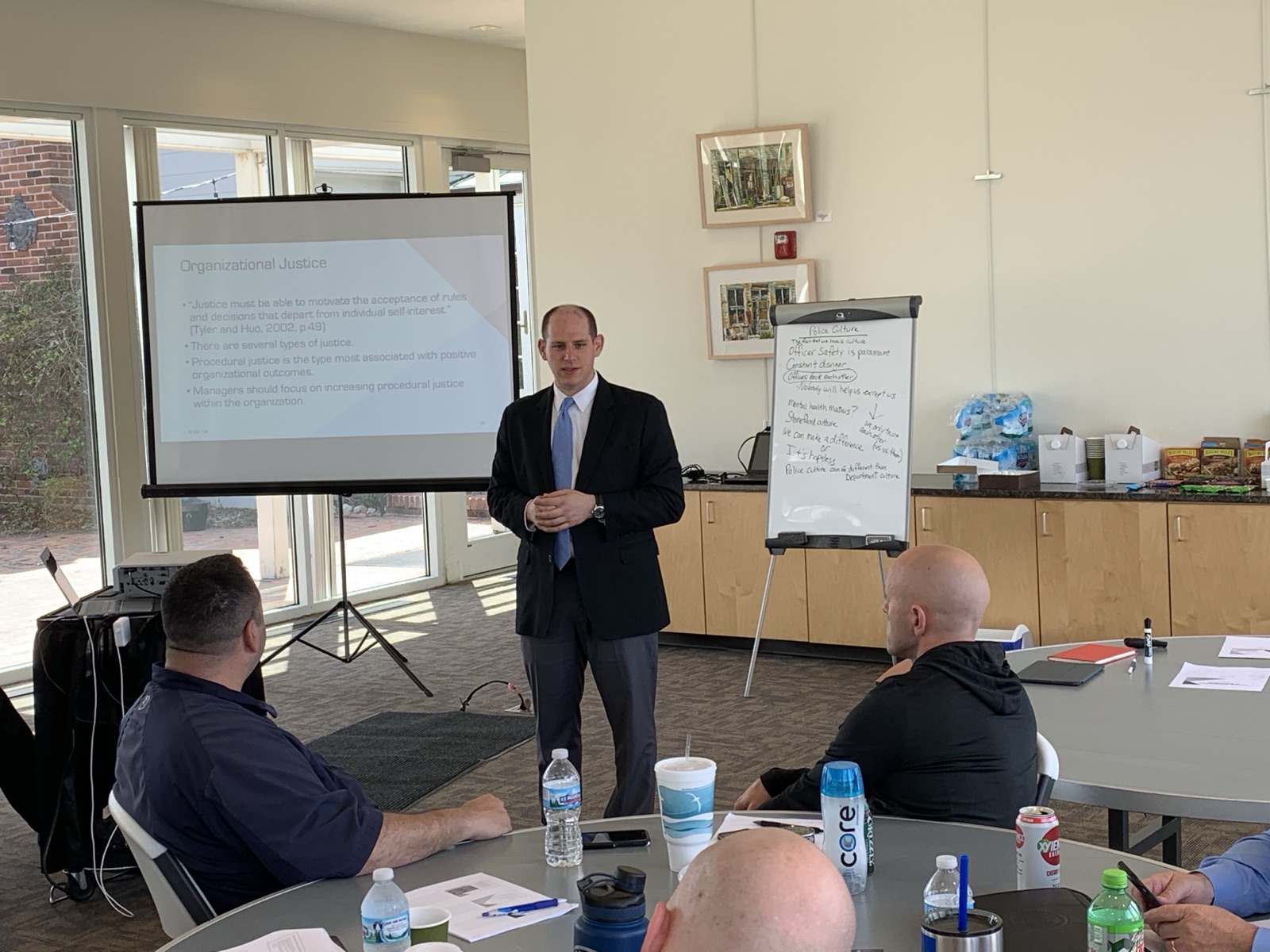
A.J. lecturing during procedural justice and leadership training
Organizational Advisory

Policy Writing and Review

Our experienced team brings years of expertise in conducting research and writing organizational policies.

Our policy review and creation process is both comprehensive and holistic, incorporating insights from numerous stakeholders and perspectives. This collaborative approach ensures that the outcome is a practical and thoroughly vetted policy, tailored to meet the specific needs of your organization.

Organizational policies, binders, and research notes
Environmental Crime Reduction

Security Assessments and Planning (CPTED)

With the use of Crime Prevention Through Environmental Design (CPTED) techniques and principles, our team will deliver security assessments and plans to reduce your organization’s liability and enhance physical safety.

We evaluate natural access control, surveillance sightlines, territorial reinforcement, and facility layout to safeguard personnel and physical assets.

Security fence and environmental perimeter protection

Other Specialized Services

In addition to our core curricula, ImproveComp provides targeted consulting including:

Sovereign Citizen Awareness Training

Briefings and tactics for dealing with paper terrorism, unlawful UCC filings, and extremist ideological encounters.

Program Evaluation

Quantitative and qualitative assessment of departmental programs, operational efficiency, and training impact.

Organizational Surveys

Custom climate, workforce morale, and stakeholder perception surveys engineered to uncover actionable institutional insight.